

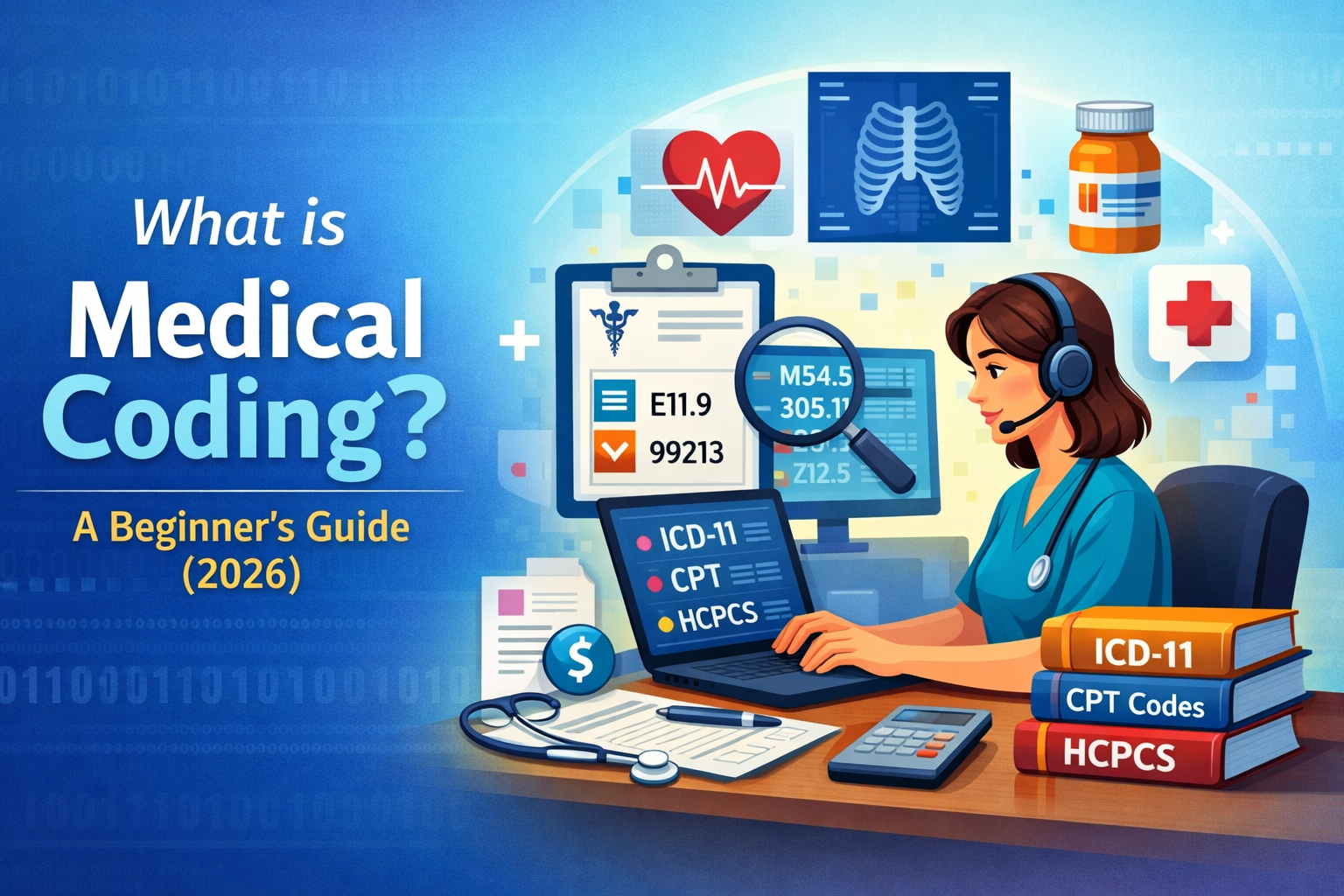
Medical coding is one of the fastest-growing non-clinical healthcare careers in 2026. As hospitals, insurance companies, and government health schemes become more digital and data-driven, the demand for skilled medical coders continues to rise — especially in countries like India, where healthcare infrastructure and insurance coverage are expanding rapidly.
If you’re exploring a stable healthcare career that combines medical knowledge, analytical thinking, and strong job security, medical coding could be the right path for you.
This beginner’s guide explains:
- What medical coding is
- How it works in real healthcare settings
- The coding systems used
- Career scope and salary expectations
- Certifications and training pathways
- How to get started in India
What Exactly is Medical Coding?
Medical coding is the process of converting healthcare diagnoses, procedures, treatments, and medical services into standardized alphanumeric codes.
These codes are used for:
- Insurance claims processing
- Hospital billing
- Reimbursement under schemes like Ayushman Bharat (PM-JAY)
- Medical record documentation
- Public health reporting
- Healthcare analytics and research
A medical coder carefully reviews:
- Doctor’s notes
- Discharge summaries
- Lab reports
- Operative records
- Radiology findings
The coder then assigns accurate codes based on international classification systems.
In simple terms:
👉 Doctors treat patients.
👉 Coders translate treatments into standardized codes.
👉 Insurance companies use those codes to process payments.
Why Medical Coding is Important in Healthcare
Medical coding is not just data entry — it is a core part of healthcare revenue and compliance systems.
- Financial Accuracy
Correct coding ensures hospitals and clinics receive proper reimbursement. Incorrect coding can result in:
- Claim rejections
- Delayed payments
- Financial losses
- Audit penalties
- Compliance & Legal Protection
Accurate coding protects healthcare providers from:
- Fraud allegations
- Insurance disputes
- Regulatory penalties
- Data for Research & Public Health
Governments and health organizations use coded data to:
- Track disease patterns
- Monitor public health trends
- Plan healthcare policies
- Continuity of Patient Care
Standardized codes ensure accurate medical history documentation, improving long-term patient care.
Understanding the Main Medical Coding Systems
Medical coders primarily use three standardized coding systems.
- ICD-10 (International Classification of Diseases)
ICD-10 codes identify diseases, symptoms, and conditions.
Examples:
- E11.9 – Type 2 diabetes without complications
- I10 – Essential hypertension
- J45.901 – Asthma with acute exacerbation
In India:
- ICD-10 is widely used for hospital reporting and insurance claims.
- Many Indian coders also learn ICD-10-CM for US-based projects.
- CPT (Current Procedural Terminology)
CPT codes describe medical procedures and services.
Examples:
- 99213 – Office visit
- 70450 – CT scan without contrast
Indian coders working in US healthcare outsourcing use CPT extensively.
- HCPCS
HCPCS codes describe:
- Medical supplies
- Equipment
- Injectable medications
These are primarily used in US-based billing projects.
Role and Responsibilities of a Medical Coder
Medical coders act as a bridge between clinical care and billing departments.
Their responsibilities include:
- Reviewing medical documentation
- Identifying primary and secondary diagnoses
- Assigning appropriate ICD and CPT codes
- Ensuring coding compliance
- Meeting productivity benchmarks
- Staying updated with annual coding changes
Attention to detail is critical — even a minor coding error can impact reimbursement.
Skills Required to Become a Medical Coder
Technical Skills
- ICD-10, CPT, HCPCS knowledge
- Medical terminology
- Anatomy & physiology
- Understanding of healthcare documentation
- Familiarity with EMR/EHR systems
Soft Skills
- Strong attention to detail
- Analytical thinking
- Time management
- Ethical integrity
- Continuous learning mindset
Career Opportunities in Medical Coding
Medical coding offers diverse employment options.
Employment Settings
- Multi-specialty hospitals
- Private clinics
- Insurance companies
- TPA firms
- Revenue cycle management companies
- Medical coding BPO/KPO firms
- Remote coding positions
Career Growth Path
Entry-Level → Senior Coder → Auditor → Coding Manager → Compliance Officer → Revenue Cycle Manager
Experienced professionals can also become:
- Coding trainers
- Medical coding consultants
- Healthcare data analysts
Institutions like NIMC (National Institute of Medical Coding) and Transorze Training Partner also recruit experienced professionals as faculty and mentors to train the next generation of coders.
Medical Coder Salary in India (2026)
Salary varies by experience, city, and certification.
Entry-Level (0–1 Year)
₹15,000 – ₹25,000 per month
2–5 Years Experience
₹30,000 – ₹60,000 per month
Senior Coder / Auditor
₹6–12 LPA
Coders working in international processes often earn higher compensation due to global billing standards.
Major hiring cities:
- Chennai
- Bangalore
- Hyderabad
- Kochi
- Coimbatore
- Pune
Certifications in Medical Coding
Professional certification improves job prospects and salary potential.
Popular Certifications:
- CCA (Certified Coding Associate)
- CCS (Certified Coding Specialist)
- CPC (Certified Professional Coder)
Training institutions such as NIMC and Transorze Training Partner provide structured preparation aligned with these certification exams, including practical case-based training and mock exams.
Educational Pathway
Most beginners complete:
- 3–6 months of structured medical coding training
- Certification exam preparation
- Practical coding case studies
When choosing a program, ensure it includes:
✔ Updated ICD-10 & CPT curriculum
✔ Practical hospital-based case training
✔ Certification exam preparation
✔ Placement guidance
✔ Industry-experienced trainers
How to Get Started in Medical Coding
Step 1: Assess Your Interest
Do you enjoy detail-oriented work and healthcare topics?
Step 2: Enroll in a Structured Program
Choose recognized institutions like NIMC or Transorze Training Partner that provide industry-aligned training.
Step 3: Complete Certification
Pass CCA, CPC, or CCS exams.
Step 4: Apply for Entry-Level Roles
Start gaining experience in hospitals or coding companies.
Step 5: Build Experience & Specialize
Move into auditing, compliance, or specialty coding.
Challenges Beginners Face
- Complex Medical Terminology
Solution: Strengthen the anatomy and terminology foundation.
- Keeping Up With Updates
ICD and CPT codes are updated annually. Continuous education is mandatory.
- Accuracy vs Speed
Focus on accuracy first — productivity improves with experience.
The Future of Medical Coding
Medical coding in 2026 is evolving with:
- AI-assisted coding tools
- Remote work expansion
- Greater demand for certified coders
- Data analytics integration
- Transition discussions toward ICD-11
Despite automation, trained human coders remain essential for compliance and complex case interpretation.
Conclusion
Medical coding is a stable, high-demand healthcare career offering structured growth and global opportunities. It combines medical knowledge with analytical precision and plays a critical role in healthcare revenue and compliance systems.
For beginners, the journey starts with proper training and certification. Established institutions such as NIMC (National Institute of Medical Coding) and Transorze Training Partner provide structured pathways that help students build practical skills and industry readiness.
If you’re detail-oriented, interested in healthcare, and seeking a professional career with growth potential, medical coding could be your ideal starting point in 2026.
Frequently Asked Questions (FAQ)
- How long does it take to become a medical coder?
Most beginners complete training in 3–6 months, followed by certification preparation.
- Do I need a medical degree?
No. Life science graduates are preferred, but non-medical graduates can enter the field with proper training.
- Can medical coders work from home?
Yes. Many experienced coders work remotely for hospitals and international clients.
- What is the difference between ICD-10 and CPT?
ICD-10 codes diagnose diseases; CPT codes describe procedures performed.
- Is medical coding a good career in India?
Yes. Growing insurance coverage and hospital expansion create consistent demand.
- What is the starting salary?
Entry-level salaries range between ₹15,000 and ₹25,000 per month.
- Is certification mandatory?
Not always, but certification significantly improves employability and salary.
- Do coding rules change frequently?
Yes. Coding systems are updated annually, requiring continuous education.