

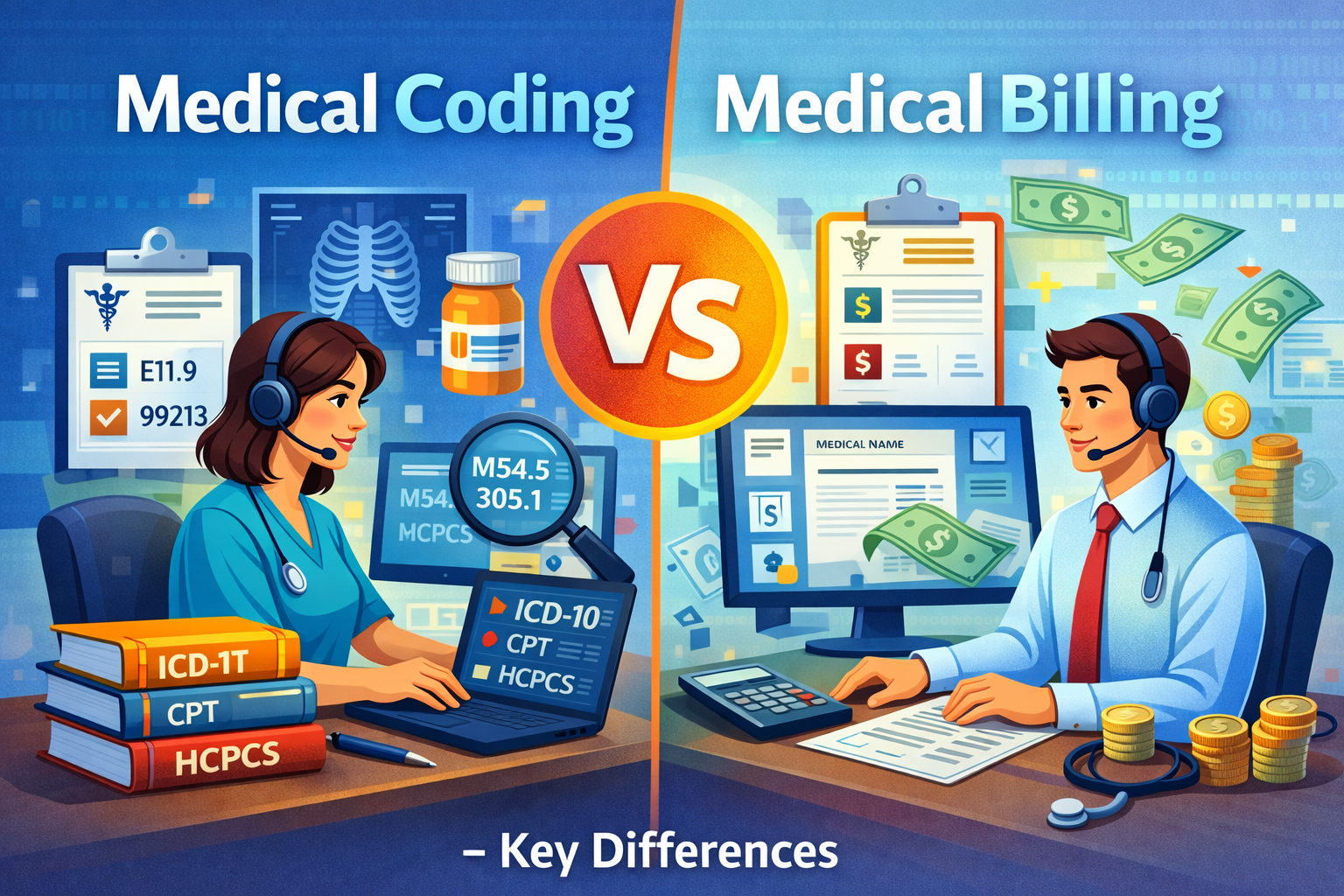
In today’s healthcare ecosystem, accurate documentation and financial management are just as important as clinical care. Yet many aspiring healthcare professionals often confuse two critical administrative roles: medical coding vs medical billing.
Although these professions work closely together in the healthcare revenue cycle, they are fundamentally different in their responsibilities, skill requirements, and career trajectories.
Understanding the distinction between medical coding vs medical billing is essential if you are:
- Considering a career in healthcare administration
- Exploring certification programs
- Managing a hospital or clinic’s revenue cycle
- Seeking clarity on job roles in the medical BPO/KPO sectors
At institutions like NIMC (National Institute of Medical Coding) and Transorze Training Partner, students are trained to clearly understand the difference between these two professions, ensuring they build the right career path based on their strengths and interests.
This guide provides an expert-backed, practical breakdown of medical coding and medical billing — including roles, certifications, salary expectations, and real-world workflow differences.
What is Medical Coding?
Medical coding is the process of translating healthcare diagnoses, procedures, and services into standardized alphanumeric codes.
Medical coders analyze clinical documentation and assign codes using globally recognized systems such as:
- ICD-10-CM – Diagnosis coding
- CPT (Current Procedural Terminology) – Procedure coding
- HCPCS Level II – Supplies and equipment coding
In India, ICD-10 is widely used for hospital reporting, insurance claims, and government schemes like PM-JAY (Ayushman Bharat).
Key Responsibilities of Medical Coders
Medical coders typically:
- Review patient charts and discharge summaries
- Assign ICD-10 diagnosis codes
- Assign CPT procedure codes
- Ensure documentation supports assigned codes
- Follow AAPC and AHIMA coding guidelines
- Query physicians for clarification when needed
- Maintain compliance with healthcare regulations
- Participate in internal coding audits
Daily Work Scenario
A coder receives a patient file for a diabetic patient admitted for foot ulcer treatment. The coder must:
- Identify the primary diagnosis (e.g., Type 2 Diabetes)
- Assign complication codes
- Code procedures performed
- Ensure documentation justifies medical necessity
Accuracy is critical — even minor coding errors can lead to claim denial.
What is Medical Billing?
Medical billing is the process of submitting, tracking, and managing healthcare claims to ensure providers receive payment for services rendered.
Medical billers use the codes assigned by coders to generate insurance claims and manage revenue collection.
Key Responsibilities of Medical Billers
Medical billers typically:
- Verify patient insurance eligibility
- Prepare and submit insurance claims
- Calculate patient responsibility (copay, deductible)
- Follow up on denied or unpaid claims
- Post payments to patient accounts
- Communicate with insurance companies
- Handle accounts receivable
- Generate patient billing statements
Daily Work Scenario
A biller receives coded data for a surgical procedure. The biller must:
- Create an electronic claim
- Submit it to the insurer
- Track claim status
- Address rejections if coding mismatches occur
- Follow up for payment
Medical billing focuses on financial processing rather than clinical interpretation.
Medical Coding vs Medical Billing – Side-by-Side Comparison
| Aspect | Medical Coding | Medical Billing |
| Primary Focus | Translating clinical documentation into codes | Managing claims and reimbursement |
| Core Input | Medical records and physician notes | Codes assigned by coders |
| Core Output | ICD-10, CPT, HCPCS codes | Insurance claims and payment reports |
| Skill Emphasis | Medical terminology, anatomy, compliance | Insurance policies, communication, financial management |
| Interaction Level | Mostly internal (physicians, auditors) | External (patients, insurance companies) |
| Error Impact | Claim denial, audit risk, compliance issues | Payment delays, revenue loss |
| Certification Bodies | AAPC, AHIMA | AAPC, billing associations |
| Career Path | Auditor, Coding Manager, Compliance Officer | Billing Manager, Revenue Cycle Manager |
When comparing medical coding vs medical billing, coding is clinically analytical, while billing is financially operational.
Where Medical Coding and Medical Billing Overlap
Despite differences, there are areas of overlap:
- Revenue Cycle Management
Both roles are essential stages in the healthcare revenue cycle.
- Compliance
Both must adhere to:
- HIPAA (for US processes)
- Insurance regulations
- Documentation standards
- Anti-fraud guidelines
- Documentation Knowledge
Billers must understand coding basics. Coders must understand billing impact.
- Software Systems
Both use:
- Practice management software
- Electronic Health Records (EHR)
- Revenue cycle systems
Understanding the interdependence in medical coding vs medical billing helps healthcare organizations improve claim acceptance rates.
Skills Required: Medical Coding vs Medical Billing
Skills for Medical Coding
- Strong medical terminology knowledge
- Anatomy & physiology understanding
- ICD-10 & CPT proficiency
- Analytical thinking
- Detail-oriented mindset
- Compliance awareness
Skills for Medical Billing
- Insurance terminology knowledge
- Communication skills
- Accounts receivable management
- Negotiation and follow-up ability
- Financial documentation accuracy
If you prefer analytical, documentation-based work, coding may suit you.
If you enjoy communication and financial processes, billing may be ideal.
Certifications and Training Pathways
- CPC (Certified Professional Coder) – AAPC
- CCS (Certified Coding Specialist) – AHIMA
- CCA (Certified Coding Associate) – AHIMA
Medical Billing Certifications
- CPB (Certified Professional Biller) – AAPC
- CBCS (Billing & Coding Specialist)
Institutions such as NIMC (National Institute of Medical Coding) and Transorze Training Partner offer structured programs that prepare students for these certifications with:
- Updated curriculum aligned to ICD-10 and CPT
- Practical case studies
- Mock exams
- Industry-oriented training
- Placement guidance
Salary Comparison (India 2026)
Medical Coding Salary
- Entry-Level: ₹15,000 – ₹25,000/month
- 2–5 Years: ₹30,000 – ₹60,000/month
- Senior Auditor: ₹6–12 LPA
Medical Billing Salary
- Entry-Level: ₹12,000 – ₹22,000/month
- Experienced: ₹25,000 – ₹50,000/month
- Billing Manager: ₹5–10 LPA
In international (US) healthcare processes, salaries may be higher depending on certification and experience.
Which Career Should You Choose?
When evaluating medical coding vs medical billing, ask yourself:
- Do I enjoy analyzing medical records? → Choose Coding
- Do I enjoy communication and financial tracking? → Choose Billing
- Do I want remote work flexibility? → Both offer options
- Do I want compliance and audit specialization? → Coding
Both careers offer:
✔ Job stability
✔ Growing demand
✔ Remote opportunities
✔ Career advancement
Frequently Asked Questions (FAQ)
- What is the main difference between medical coding and medical billing?
Medical coding converts medical documentation into standardized codes, while medical billing uses those codes to submit claims and collect payment.
- Can one person do both medical coding and medical billing?
Yes. Smaller clinics often combine roles. However, larger hospitals typically separate these responsibilities.
- Which is harder – medical coding or medical billing?
Medical coding requires deeper medical knowledge and analytical skills. Billing requires communication and insurance expertise. Difficulty depends on individual strengths.
- Is certification necessary for both roles?
Certification is not legally mandatory but highly recommended. Employers prefer certified professionals.
- Which profession pays more?
Generally, certified medical coders earn slightly higher salaries, especially in auditing and compliance roles.
- Can both roles be done remotely?
Yes. Many coders and billers work remotely, especially in international healthcare outsourcing.
- How long does training take?
Most programs range from 3 to 6 months, depending on intensity and certification preparation.
- Do coding and billing rules change often?
Yes. ICD and CPT codes are updated annually. Continuous education is essential.
Conclusion
Understanding medical coding vs medical billing is critical for choosing the right healthcare career path. While both professions are interconnected within the revenue cycle, their responsibilities, skill sets, and growth opportunities differ significantly.
Medical coding focuses on clinical accuracy and compliance.
Medical billing focuses on financial management and reimbursement.
Both are essential pillars of healthcare administration.
If you are planning to start your career in this field, structured training from recognized institutions like NIMC (National Institute of Medical Coding) and Transorze Training Partner can provide the knowledge, certification preparation, and industry exposure needed to succeed.
The healthcare system relies on skilled coders and billers — and with the right training, you can become one of them.