

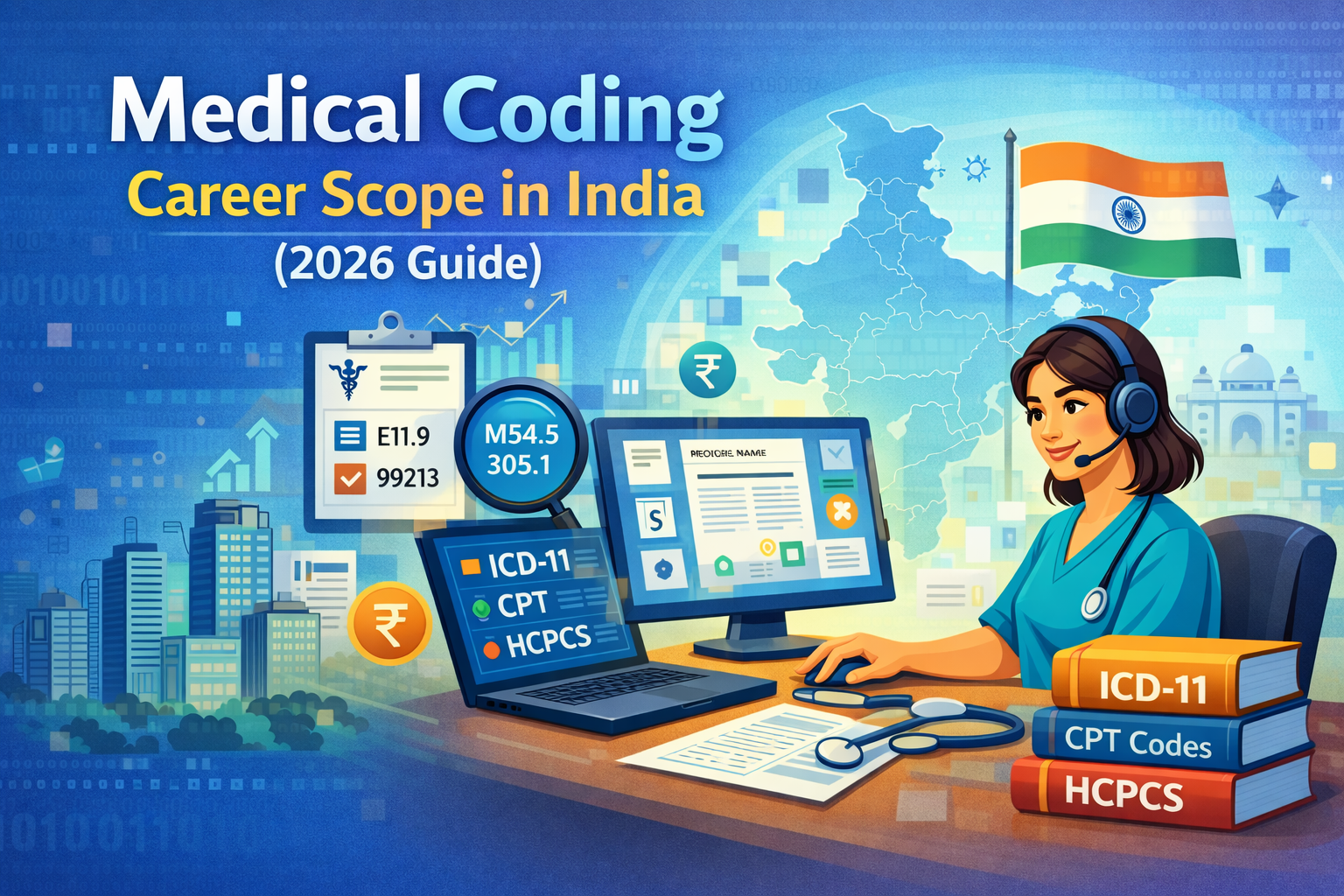
The Indian healthcare industry is undergoing rapid digital transformation. With increasing health insurance penetration, government health schemes like Ayushman Bharat, expanding hospital networks, and global outsourcing opportunities, medical coding has emerged as one of the fastest-growing healthcare careers in India.
If you’re exploring a stable, skill-based profession with strong global demand, understanding the Medical Coding Career Scope in India is crucial before making a decision.
This comprehensive guide explains career opportunities, salary prospects, required skills, certifications, industry trends, and how institutions like NIMC (National Institute of Medical Coding) and Transorze Training Partner help students build credible careers in this field.
What is Medical Coding?
Medical coding is the process of converting healthcare diagnoses, procedures, services, and equipment into standardized alphanumeric codes. These codes are used for:
- Insurance claim processing
- Medical billing
- Hospital record maintenance
- Government reporting
- Healthcare analytics
- Regulatory compliance
Common coding systems include:
- ICD-10-CM – Diagnosis coding
- ICD-10-PCS – Inpatient procedure coding
- CPT (Current Procedural Terminology) – Outpatient procedures
- HCPCS – Supplies and additional services
In India, medical coding professionals often work on US healthcare projects, making this a globally aligned profession with strong export-driven demand.
Why Medical Coding Career Scope in India is Growing Rapidly
- Expansion of the Indian Healthcare Sector
India’s healthcare sector is projected to cross USD 370+ billion in the coming years. Growth drivers include:
- Corporate hospital expansion
- Medical tourism
- Digital health records implementation
- Insurance penetration growth
- Government health schemes
Each patient visit generates documentation that must be coded accurately — increasing demand for trained professionals.
- Rising Health Insurance & Claim Processing
With schemes like:
- Ayushman Bharat (PM-JAY)
- State government health insurance programs
- Private insurance policies
Accurate coding is essential for claim approvals. Incorrect coding can lead to claim rejection or compliance issues. This makes certified coders highly valuable.
- India as a Global Outsourcing Hub
India is a leading destination for healthcare BPO and medical coding outsourcing. Major US healthcare companies outsource coding operations to Indian firms due to:
- Skilled workforce
- Cost efficiency
- English proficiency
- Time zone advantage
This ensures sustained job opportunities across metropolitan and Tier-2 cities.
Medical Coding Jobs in India
The range of medical coding jobs in India continues to expand. Career options include:
Entry-Level Roles
- Medical Coder
- Junior Coding Executive
- Medical Billing Executive
- Coding Analyst Trainee
Mid-Level Roles
- Senior Medical Coder
- Coding Auditor
- Quality Analyst
- Team Leader
Advanced Roles
- Coding Manager
- Compliance Officer
- Clinical Documentation Specialist
- Healthcare Data Analyst
Work Environments
- Multi-specialty hospitals
- Healthcare BPO companies
- Insurance firms
- Third-party administrators (TPAs)
- Medical billing companies
- Remote/work-from-home roles
With experience, professionals can also pursue international certifications and work with global healthcare providers.
Medical Coding Salary in India (2026 Overview)
One of the biggest attractions of this profession is the competitive salary structure relative to entry barriers.
Entry-Level (0–2 Years)
₹15,000 – ₹30,000 per month
₹1.8 – ₹3.6 LPA
Mid-Level (3–5 Years)
₹3.5 – ₹6 LPA
Senior-Level (6+ Years)
₹6 – ₹12+ LPA
Specialized Roles (Certified & Auditors)
₹8 – ₹18 LPA (depending on certification and employer)
Salary depends on:
- Certification status
- Specialization (Surgery, Radiology, Cardiology, coding, etc.)
- Employer type (MNC vs local firm)
- Location (Chennai, Bangalore, Hyderabad offer higher packages)
Professionals with strong auditing skills and international certifications command premium compensation.
Required Skills for a Successful Medical Coding Career
To succeed in the Medical Coding Career Scope in India, candidates must develop:
- Strong Anatomy & Physiology Knowledge
Understanding body systems and medical terminology is foundational.
- Attention to Detail
Even a minor coding error can result in claim denial.
- Analytical Skills
Interpreting clinical documentation accurately is critical.
- Compliance Awareness
Understanding healthcare regulations and documentation standards.
- Communication Skills
Interacting with physicians and billing teams requires clarity and professionalism.
- Technical Skills
Familiarity with:
- Electronic Health Records (EHR)
- Medical billing software
- Coding guidelines updates
Professional training institutions like NIMC (National Institute of Medical Coding) and Transorze Training Partner emphasize practical coding exercises, live case studies, and compliance-focused training to build these competencies.
Educational Pathways & Medical Coding Certification
You don’t need an MBBS degree to enter this field. However, candidates with the following backgrounds have an advantage:
- BSc (Nursing)
- BPharm
- BSc Biotechnology
- Life Sciences graduates
- Allied health professionals
- Non-medical graduates (with proper training)
A structured training program typically includes:
- Medical terminology
- Anatomy & Physiology
- ICD-10-CM
- CPT coding
- HCPCS
- Claim processing workflow
- Compliance & ethics
- Mock exams & live projects
Institutions like NIMC and its training associate Transorze Training Partner focus on industry-oriented medical coding courses that prepare students for real-time project environments.
Importance of Medical Coding Certification
Certifications improve employability and salary prospects. Popular certifications include:
- CPC (Certified Professional Coder)
- CCS (Certified Coding Specialist)
- CCA
- Specialty certifications
Certified candidates are preferred by multinational healthcare companies and coding firms.
Career Growth & Long-Term Scope
Medical coding is not a stagnant career. Growth pathways include:
- Specialization
- Surgical coding
- Inpatient coding
- Oncology coding
- Cardiology coding
- Quality & Auditing
Auditors verify coding accuracy and ensure compliance.
- Management Roles
Team leads and coding managers handle operations.
- International Opportunities
With global certifications, professionals can work abroad or remotely for US firms.
- Healthcare Analytics & AI
Coders with data analysis skills can transition into health informatics and analytics roles.
Industry Trends Shaping Medical Coding in India (2026)
- Increased adoption of AI-assisted coding
- Greater demand for compliance auditing
- Remote and hybrid work models
- Stronger integration of EHR systems
- Expansion of medical coding hubs in Tier-2 cities
While AI supports coding efficiency, human coders remain essential for accuracy, complex case interpretation, and compliance validation.
Why Choose Structured Training Before Entering the Field?
Medical coding is skill-driven. Self-learning is possible but often insufficient for employment.
A structured training institute ensures:
- Updated coding guidelines
- Hands-on practice
- Mock interviews
- Placement support
- Industry exposure
Organizations such as NIMC (National Institute of Medical Coding), in collaboration with Transorze Training Partner, are recognized for offering structured training pathways aligned with current industry demands in India.
Is Medical Coding a Good Career Choice in India?
Yes — particularly if you are looking for:
- A stable healthcare career
- Non-clinical work environment
- Opportunities to work with international clients
- Career growth without extensive higher education
- Work-from-home potential
The Medical Coding Career Scope in India continues to expand due to healthcare digitization and global outsourcing demand.
Frequently Asked Questions (FAQ)
- What is the scope of medical coding in India in 2026?
The scope is strong and expanding due to healthcare digitization, insurance growth, and outsourcing demand from US healthcare providers.
- Is medical coding a good career for freshers?
Yes. Fresh graduates from life sciences and healthcare backgrounds can start as junior coders and grow with experience.
- What is the starting medical coding salary in India?
Entry-level salaries range from ₹1.8 LPA to ₹3.6 LPA depending on skills, location, and certification.
- Do I need a medical degree for medical coding?
No. A medical background helps, but structured training and certification are sufficient.
- Which certification is best for medical coding?
CPC is widely recognized internationally, while other certifications add specialization value.
- Can medical coders work from home?
Yes. Many companies offer remote coding roles, especially for experienced professionals.
- How long does it take to complete a medical coding course?
Typically 3–6 months depending on the training program structure.
- Is medical coding stressful?
The job requires attention to detail but is less physically demanding than clinical roles.
- What skills are most important in medical coding?
Anatomy knowledge, attention to detail, analytical ability, and compliance awareness.
Conclusion: Building a Future in Medical Coding
The Medical Coding Career Scope in India is promising, future-ready, and globally connected. As healthcare systems expand and digitize, the demand for trained coding professionals will only increase.
Whether you are a graduate exploring healthcare careers or a working professional seeking a stable, skill-based profession, medical coding offers:
- Job stability
- International exposure
- Attractive salary growth
- Remote work flexibility
Choosing the right training pathway is essential. Institutions such as NIMC (National Institute of Medical Coding) and Transorze Training Partner have contributed to building skilled medical coding professionals aligned with industry standards.
If you are serious about entering this growing healthcare domain, start by researching certified medical coding courses and gaining structured training that prepares you for real-world projects.