

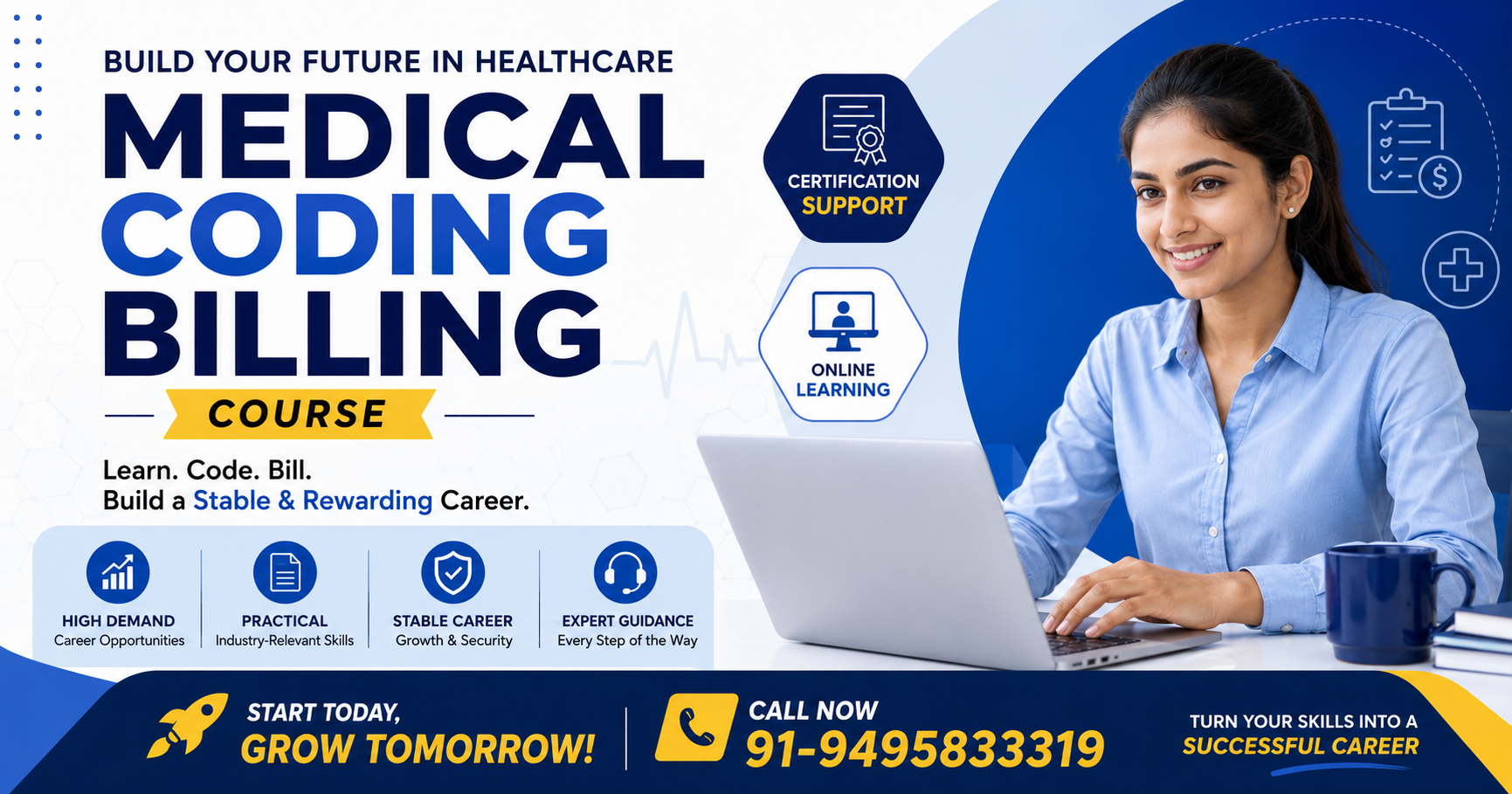
Healthcare organizations rely on accurate documentation, coding, and billing to ensure smooth operations and proper reimbursement. A medical coding billing course is designed to help students develop the knowledge and practical skills required to work in this growing healthcare field.
Whether you are a recent graduate, a life sciences student, a healthcare professional looking for a career transition, or someone seeking a stable work environment, medical coding and billing can offer a structured career path with opportunities in hospitals, clinics, insurance companies, healthcare BPOs, and revenue cycle management organizations.
What Is a Medical Coding Billing Course?
A medical coding billing course combines two closely connected healthcare functions:
Medical Coding
Medical coding involves translating medical diagnoses, procedures, treatments, and services into standardized alphanumeric codes. Healthcare providers use these codes for documentation, insurance claims, reporting, and reimbursement.
Common coding systems include:
- ICD-10-CM for diagnoses
- CPT for medical procedures
- HCPCS for healthcare services and supplies
Medical Billing
Medical billing focuses on submitting and following up on insurance claims. Medical billers ensure healthcare providers receive accurate payments for services rendered.
Billing professionals work with:
- Insurance companies
- Healthcare providers
- Patient records
- Claims processing systems
- Revenue cycle management workflows
A quality medical coding course teaches both coding accuracy and billing processes, creating professionals who understand the complete healthcare reimbursement cycle.
Why Choose a Medical Coding and Billing Career?
The healthcare industry generates enormous amounts of clinical documentation every day. Every patient visit, diagnosis, procedure, and treatment must be accurately recorded and processed.
This creates consistent demand for trained medical coding and billing professionals.
Some advantages of pursuing this career include:
- Entry into the healthcare industry without direct patient care
- Growing demand for skilled professionals
- Opportunities in hospitals and healthcare outsourcing companies
- Potential for remote and hybrid work arrangements
- Clear certification pathways
- Structured career progression
Many employers value candidates who understand both coding and billing because they can contribute across multiple stages of the revenue cycle.
What Will You Learn in a Medical Coding Billing Course?
A comprehensive training program typically covers:
Medical Terminology
Students learn the language of healthcare, including:
- Anatomical terminology
- Body systems
- Diseases and disorders
- Diagnostic procedures
- Clinical abbreviations
Human Anatomy and Physiology
Understanding how the body functions helps coders accurately interpret physician documentation and assign appropriate codes.
ICD-10-CM Coding
Training includes:
- Coding guidelines
- Diagnosis classification
- Documentation review
- Case studies and coding exercises
CPT and HCPCS Coding
Students learn how to code:
- Physician services
- Surgical procedures
- Laboratory testing
- Radiology services
- Medical supplies
Medical Billing Fundamentals
Topics generally include:
- Insurance claim processing
- Reimbursement methodologies
- Claims submission
- Denial management
- Payment posting
- Revenue cycle management
Compliance and Healthcare Regulations
Students are introduced to:
- Documentation standards
- Coding ethics
- Healthcare compliance requirements
- Data privacy principles
Who Can Join a Medical Coding Billing Course?
Medical coding and billing training is suitable for:
- Life science graduates
- Nursing graduates
- Pharmacy graduates
- Biotechnology graduates
- Allied health professionals
- Medical transcription professionals
- Fresh graduates seeking healthcare careers
Many institutes also provide beginner-friendly training pathways for candidates with limited healthcare experience.
Online Learning for Medical Coding and Billing
The demand for flexible education has increased significantly. Online training allows students to learn from anywhere while balancing work, studies, or family responsibilities.
NIMC (National Institute of Medical Coding) offers online classes that help students gain coding and billing knowledge through structured training, instructor support, and industry-focused curriculum delivery.
Online programs often include:
- Live virtual classes
- Recorded sessions
- Coding practice exercises
- Mock assessments
- Certification preparation
- Career guidance
Certifications That Strengthen Your Career
Professional certifications can improve employability and demonstrate coding proficiency.
Popular certification pathways may include:
- CPC (Certified Professional Coder)
- CCS (Certified Coding Specialist)
- CCA (Certified Coding Associate)
- Specialty coding credentials
Certification preparation is often an important component of a quality medical coding billing course because many employers prefer certified candidates.
Career Opportunities After Completing a Medical Coding Billing Course
After successful training, professionals may pursue roles such as:
Medical Coder
Reviews clinical documentation and assigns appropriate diagnosis and procedure codes.
Medical Billing Specialist
Handles claims submission, reimbursement tracking, and insurance communication.
Coding Auditor
Evaluates coding accuracy and compliance with industry standards.
Revenue Cycle Executive
Supports billing operations and healthcare reimbursement workflows.
Healthcare Documentation Specialist
Works with healthcare records and clinical information management.
Industries hiring coding and billing professionals include:
- Hospitals
- Multi-specialty clinics
- Insurance companies
- Healthcare consulting firms
- Medical billing organizations
- Revenue cycle management companies
- Healthcare BPOs
Skills Employers Look For
Successful medical coding and billing professionals typically possess:
- Attention to detail
- Analytical thinking
- Documentation review skills
- Knowledge of coding guidelines
- Communication skills
- Computer proficiency
- Accuracy under deadlines
Training programs that emphasize practical case studies often help students develop these skills more effectively.
How to Choose the Right Medical Coding Billing Course
Before enrolling, evaluate:
Curriculum Coverage
Ensure the program covers coding systems, billing workflows, medical terminology, and compliance requirements.
Faculty Expertise
Look for trainers with real-world coding and billing experience.
Certification Support
Programs aligned with recognized certification pathways can provide additional value.
Practical Training
Case studies and coding exercises are essential for developing job-ready skills.
Placement Assistance
Career guidance and interview preparation can help students transition into the workforce more smoothly.
Future Scope of Medical Coding and Billing
Healthcare organizations continue to focus on accurate documentation, compliance, and revenue management. As healthcare services expand globally, the need for trained coding and billing professionals remains strong.
Professionals who continuously upgrade their skills, gain certifications, and stay updated with coding guidelines often find opportunities for career advancement into auditing, quality analysis, education, and healthcare management roles.
For students seeking a healthcare career that combines analytical work, structured processes, and long-term growth potential, a medical coding billing course can provide a strong foundation.
FAQ’s
1. What is the scope of medical coding?
Medical coding has strong career potential because healthcare providers, hospitals, insurance companies, and healthcare outsourcing firms require accurate coding for reimbursement and compliance. Skilled coders can progress into auditing, quality assurance, and leadership roles.
2. How long does it take to learn medical billing?
Most medical billing programs can be completed within a few months, depending on the course structure, learning pace, and practical training requirements. Comprehensive programs often combine billing fundamentals with coding education.
3. What are medical coding certifications?
Medical coding certifications validate a professional’s coding knowledge and industry readiness. Popular certifications include CPC, CCS, and CCA. Employers often view certification as an indicator of competency and commitment.
4. Can I learn medical coding and billing online?
Yes. Many training providers offer online classes with live instruction, recorded sessions, coding practice exercises, assessments, and certification preparation resources.
5. Is medical coding and billing a good career choice?
For individuals interested in healthcare, documentation, and analytical work, medical coding and billing can provide stable career opportunities, professional growth, and exposure to the healthcare industry without direct patient care responsibilities.
6. What qualifications are needed for a medical coding billing course?
Many programs accept graduates from life sciences, nursing, pharmacy, biotechnology, and allied healthcare backgrounds. Some beginner-friendly courses also welcome candidates from other educational streams.
7. What is the difference between medical coding and medical billing?
Medical coding converts healthcare documentation into standardized codes, while medical billing uses those codes to create and process insurance claims and payment workflows. Both functions work together within the healthcare revenue cycle.
Conclusion
A medical coding billing course offers a valuable pathway into the healthcare industry for individuals seeking a stable, rewarding, and growth-oriented career. By transorze‘s combining expertise in medical coding, billing procedures, healthcare documentation, and insurance claim management, professionals become essential contributors to the healthcare revenue cycle. With increasing demand for skilled coders and billers across hospitals, insurance companies, healthcare BPOs, and revenue cycle management organizations, this field continues to provide promising employment opportunities. Choosing a comprehensive training program with practical learning, certification support, and industry exposure can help students build the skills and confidence needed to succeed in the evolving healthcare sector.