

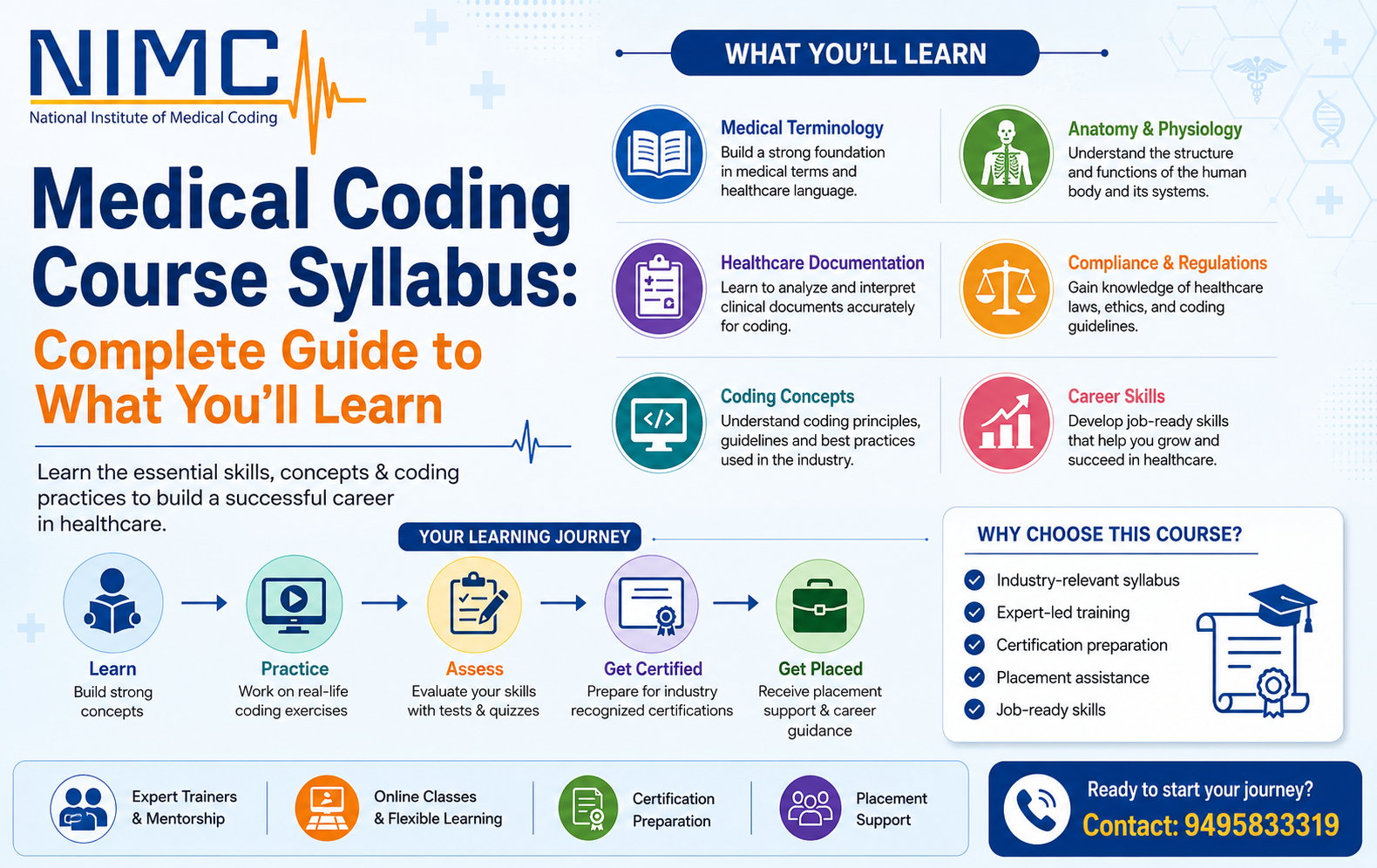
If you’re considering a career in healthcare administration, understanding the medical coding course syllabus is one of the most important steps before enrolling in a training program. The syllabus gives you a clear picture of the subjects covered, coding systems you’ll learn, industry standards you’ll follow, and the practical skills needed to work as a professional medical coder.
Medical coding plays a critical role in healthcare by translating patient diagnoses, treatments, and procedures into standardized codes used for billing, insurance claims, reimbursement, and healthcare analytics. Because of this responsibility, quality training programs follow a structured curriculum designed to build both medical knowledge and coding expertise.
Whether you’re a recent graduate, healthcare professional, life science student, or someone looking to transition into a stable healthcare career, understanding the syllabus can help you choose the right course and prepare for certification success.
Why the Medical Coding Course Syllabus Matters
A well-designed syllabus does more than teach coding manuals. It helps students develop:
- Strong understanding of medical terminology
- Knowledge of human anatomy and physiology
- Familiarity with healthcare documentation
- Expertise in diagnostic and procedural coding systems
- Compliance and regulatory awareness
- Certification exam readiness
- Industry-relevant practical skills
Employers often prefer candidates who have completed comprehensive training that combines theoretical knowledge with real-world coding practice.
Core Subjects Included in a Medical Coding Course Syllabus
While course structures may vary slightly between institutions, most professional medical coding programs include the following modules.
1. Introduction to Healthcare and Medical Coding
Students begin by learning how healthcare systems operate and where medical coding fits within the revenue cycle.
Topics Covered
- Healthcare industry overview
- Role of medical coders
- Medical records and documentation
- Revenue cycle management fundamentals
- Insurance and reimbursement basics
- Compliance and ethical practices
Learning Outcome
Students gain foundational knowledge of healthcare workflows and understand why accurate coding is essential.
2. Medical Terminology
Medical terminology forms the language of healthcare. Coders must understand clinical documentation before assigning codes.
Topics Covered
- Medical prefixes and suffixes
- Root words
- Disease terminology
- Diagnostic terminology
- Surgical terminology
- Pharmacology basics
Learning Outcome
Students learn to interpret physician notes and medical records accurately.
3. Human Anatomy and Physiology
A strong understanding of body systems helps coders assign accurate diagnostic and procedural codes.
Topics Covered
- Skeletal system
- Muscular system
- Cardiovascular system
- Respiratory system
- Digestive system
- Nervous system
- Reproductive system
- Endocrine system
Learning Outcome
Students understand body structures, functions, and disease processes relevant to coding.
4. ICD Coding System
International Classification of Diseases (ICD) coding is a core component of every medical coding course syllabus.
Topics Covered
- ICD code structure
- Diagnosis coding guidelines
- Chapter-specific coding rules
- Disease classification
- Coding conventions
- Sequencing principles
Learning Outcome
Students learn to assign accurate diagnosis codes based on provider documentation.
5. CPT Coding
Current Procedural Terminology (CPT) coding focuses on procedures and services performed by healthcare providers.
Topics Covered
- Evaluation and management coding
- Surgical procedures
- Radiology coding
- Pathology and laboratory coding
- Medicine section coding
- CPT modifiers
Learning Outcome
Students develop procedural coding expertise required for outpatient and physician services.
6. HCPCS Coding
Healthcare Common Procedure Coding System (HCPCS) codes cover products, supplies, and services not included in CPT.
Topics Covered
- HCPCS Level II structure
- Durable medical equipment
- Ambulance services
- Medical supplies
- Coding guidelines
Learning Outcome
Students understand supplementary coding systems used in healthcare reimbursement.
7. Medical Documentation Review
Coding accuracy depends on proper documentation interpretation.
Topics Covered
- Physician documentation standards
- Clinical reports
- Operative notes
- Progress notes
- Discharge summaries
- Documentation improvement concepts
Learning Outcome
Students learn how to review and analyze patient records efficiently.
8. Compliance and Healthcare Regulations
Modern coding professionals must follow strict regulatory guidelines.
Topics Covered
- HIPAA fundamentals
- Coding compliance
- Fraud and abuse prevention
- Data privacy standards
- Audit preparation
- Documentation requirements
Learning Outcome
Students understand legal and ethical responsibilities within healthcare organizations.
9. Medical Billing Fundamentals
Many training programs include billing concepts to provide a complete understanding of healthcare reimbursement.
Topics Covered
- Claims submission
- Insurance verification
- Payment posting
- Denial management
- Revenue cycle processes
Learning Outcome
Students understand how coding affects billing accuracy and reimbursement outcomes.
10. Practical Coding Exercises
Hands-on practice is often the most valuable component of a medical coding course.
Topics Covered
- Case studies
- Real-world coding scenarios
- Coding simulations
- Documentation analysis
- Accuracy assessment
Learning Outcome
Students gain confidence applying coding guidelines in practical situations.
Certification Preparation Included in the Syllabus
Many students enroll specifically to prepare for professional certification examinations.
A quality syllabus typically includes:
- Certification-focused coding practice
- Mock examinations
- Exam strategy sessions
- Coding guideline updates
- Time management techniques
- Case-based assessments
These elements help students become familiar with exam formats and improve performance.
How Online Medical Coding Courses Structure Learning
Online medical coding training has become increasingly popular because it provides flexibility without sacrificing curriculum depth.
Students generally progress through:
Foundation Phase
- Medical terminology
- Anatomy and physiology
- Healthcare fundamentals
Core Coding Phase
- ICD coding
- CPT coding
- HCPCS coding
Advanced Learning Phase
- Compliance
- Documentation review
- Specialty coding concepts
Certification Readiness Phase
- Practice tests
- Coding assessments
- Mock examinations
- Interview preparation
This structured approach helps learners build knowledge progressively.
How NIMC Structures Its Online Medical Coding Training
NIMC [National Institute of Medical Coding] follows a career-focused approach that combines foundational medical sciences, coding guidelines, practical coding exercises, certification preparation, and industry-oriented training. The curriculum is designed to help students move from basic healthcare concepts to advanced coding applications while receiving structured online instruction and hands-on practice.
Students benefit from instructor-led online classes, coding case studies, assessment-based learning, and preparation aligned with current healthcare industry requirements. This approach helps learners develop both coding accuracy and job-ready confidence.
Skills You Can Expect to Gain
Upon completing a comprehensive medical coding course syllabus, students typically develop:
- Medical terminology proficiency
- Clinical documentation interpretation
- ICD coding skills
- CPT coding expertise
- HCPCS coding knowledge
- Compliance awareness
- Healthcare reimbursement understanding
- Coding audit readiness
- Problem-solving skills
- Certification exam preparedness
These competencies are highly valued across healthcare organizations, insurance companies, medical billing firms, and healthcare support services.
Who Should Enroll in a Medical Coding Course?
Medical coding training can be suitable for:
- Life science graduates
- Nursing graduates
- Pharmacy graduates
- Allied health professionals
- Healthcare administrators
- Medical transcription professionals
- Career changers interested in healthcare
A structured syllabus ensures that even students without prior coding experience can learn step by step.
FAQ
What does a medical coding course syllabus usually include?
Most medical coding syllabi include medical terminology, anatomy and physiology, ICD coding, CPT coding, HCPCS coding, healthcare documentation, compliance regulations, and practical coding exercises. Many programs also include certification preparation.
How long does it take to complete a medical coding course?
Course duration varies by institution and learning format. Many online programs can be completed within a few months, while more comprehensive programs may extend longer to include advanced coding practice and certification preparation.
Is anatomy and physiology important in medical coding?
Yes. Coders regularly interpret clinical documentation related to body systems, diseases, and procedures. Anatomy and physiology knowledge helps improve coding accuracy and understanding of medical records.
Does a medical coding course include certification exam preparation?
Many quality programs integrate exam-focused training, mock tests, coding practice exercises, and review sessions to help students prepare for certification examinations.
Can beginners understand a medical coding course syllabus?
Absolutely. Most programs begin with foundational topics such as medical terminology and anatomy before progressing to coding systems, making them accessible to beginners.
What coding systems are taught in medical coding courses?
The primary coding systems include ICD for diagnoses, CPT for medical procedures, and HCPCS for healthcare products and services. These form the foundation of professional coding work.
Are online medical coding classes effective?
Yes. Well-structured online classes provide access to instructors, coding exercises, assessments, and certification preparation while offering the flexibility to learn from anywhere.
Start Building a Career in Medical Coding
Choosing the right medical coding course begins with understanding the syllabus. A comprehensive curriculum should provide a balanced mix of medical knowledge, coding expertise, practical application, and certification preparation.
When evaluating training programs, look for structured online learning, experienced instructors, practical coding exercises, and a syllabus that progresses from fundamentals to advanced coding concepts. The right training can help you develop industry-relevant skills and prepare for long-term success in the healthcare sector.